

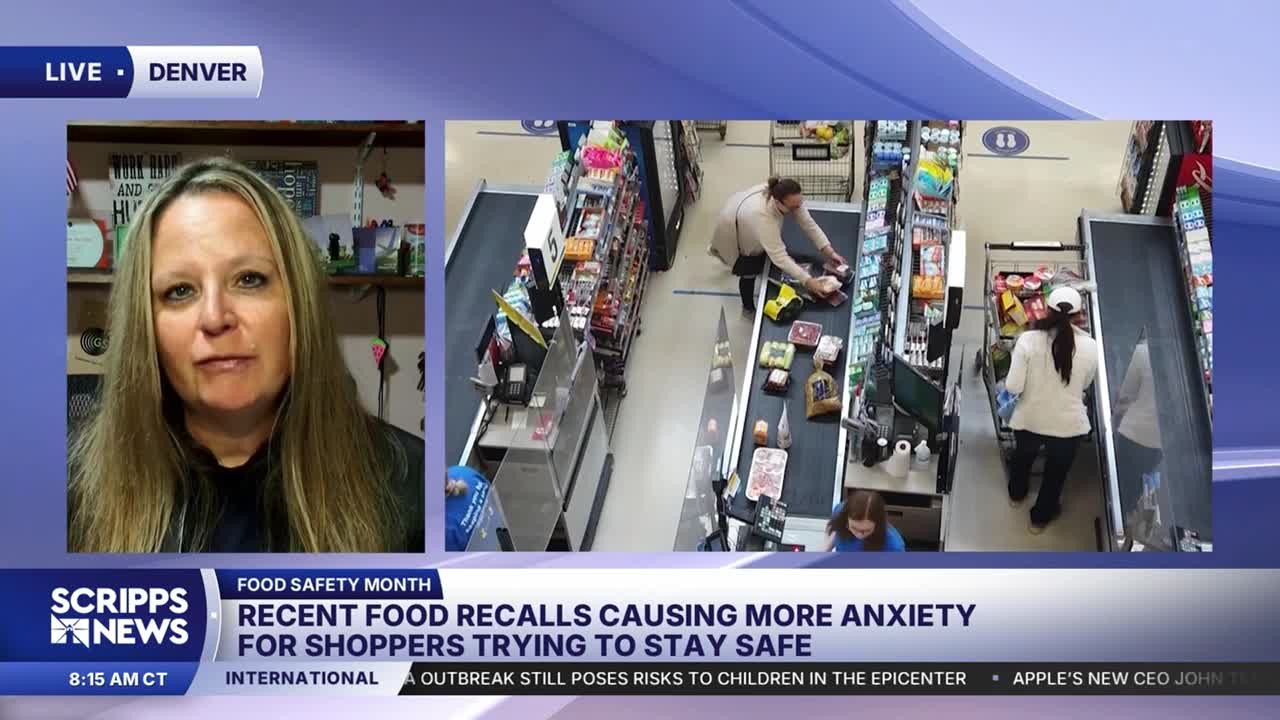


A growing number of Americans are losing trust in the food supply. A new survey by GS1 US finds 67% of Americans are avoiding an entire food category after a recall, and two-thirds say they are hesitant to buy the same product or brand again.
Melanie Nuce-Hilton, Senior Vice President of Customer Success at GS1 US, said the trend reflects a communication gap more than a safety failure.
"I think that transparency from the industry is important, but the fact that we're able to get information about recalls into the hands of consumers so quickly to me indicates that we've got a proactive system that's really focused on communication and hopefully better education as we work on the advancements in science and traceability," Nuce-Hilton said.
RELATED STORY | Recall issued for this mango brand due to possible Salmonella contamination
With more than 160 recalls already recorded this year, the volume of alerts can feel alarming. But Nuce-Hilton said the number itself can be misleading.
"There's not really a need for panic. And recalls can be for a variety of reasons. I think as we've seen this summer, some of them are preemptive, and some of them are responsive to an adverse event. So that proactive and responsive food safety system, to me, demonstrates that it's working," Nuce-Hilton said.
Why one recall can scare consumers away from an entire category
Researchers call it the "halo effect" — when a single contaminated product causes consumers to distrust an entire food category. Nuce-Hilton said the problem comes down to how recalls are communicated.
"Most often recalls are limited to a very specific production region or date range, but because the information on product packaging is really hard for consumers to discern, it makes it challenging for them to know, is it this specific product? And so in the absence of information, they'll just go to total avoidance, which actually then leads to more food waste," Nuce-Hilton said.
QR codes could replace guesswork at the grocery store
GS1 US, a standards organization, has been working with the food industry to move beyond traditional UPC barcodes toward 2D codes, like QR codes, that can carry far more product information.
"In the future, as we bring those QR codes more and more online, we'll be able to put batch lot information right into the QR code, and the consumer can scan it with their mobile phone, and it can act as sort of a red light, green light. Red light, not safe to eat. Green light, can be consumed," Nuce-Hilton said.
Nuce-Hilton said the technology could also work at the point of sale, preventing recalled products from being purchased before a consumer even realizes there is a problem.
"We can even prevent recalled foods from being sold when the data is in the barcode, which is what the register is interacting with," Nuce-Hilton said.
Retailers have set 2027 as the target date to accept QR codes and other 2D codes at checkout. A federal regulation known as FSMA Rule 204, part of the Food Traceability Rule enacted by the U.S. Food and Drug Administration, goes into effect in July 2028 and will require companies to maintain records from harvest or production all the way through to the point of sale.
Nuce-Hilton said regulation, expanded data availability, and mobile phone connectivity are all converging.
What consumers can do right now
For shoppers who hear about a recall while standing in a grocery store, Nuce-Hilton offered practical steps to take today.
"Look at the UPC code on the product. A lot of times in the retailer's app, you can scan it on your phone. You can also go to foodsafety.gov, which provides a recall alert service from the Food and Drug Administration and the U.S. Department of Agriculture," Nuce-Hilton said.
She also encouraged consumers to follow developments in barcode and traceability technology.
RELATED STORY | Taylor Farms recalls jalapeño products in 26 states over salmonella contamination concerns
"Watch the horizon and start to see the announcements being made around advances in technology and barcodes on package, as well as additional data that will be flowing through traceability systems and hopefully improving that visibility to the consumer," Nuce-Hilton said.
Rebuilding trust will take more than technology
When asked what the food industry must do differently to win back consumer confidence, Nuce-Hilton pointed to a combination of communication and action.
"Continuing to communicate is important and backing up that communication with action. So, the investments we're making in improving traceability systems, it is also an important part. So, continuing to share that journey, I always like to say that I think people want to be heard and they just want to be armed with information," Nuce-Hilton said.
She said precision in recall messaging will be key to restoring confidence.
"Very specific batches and lots are usually the subject of recall and our ability to convey that extremely clearly to the consumer is probably also going to help increase confidence," Nuce-Hilton said.


