

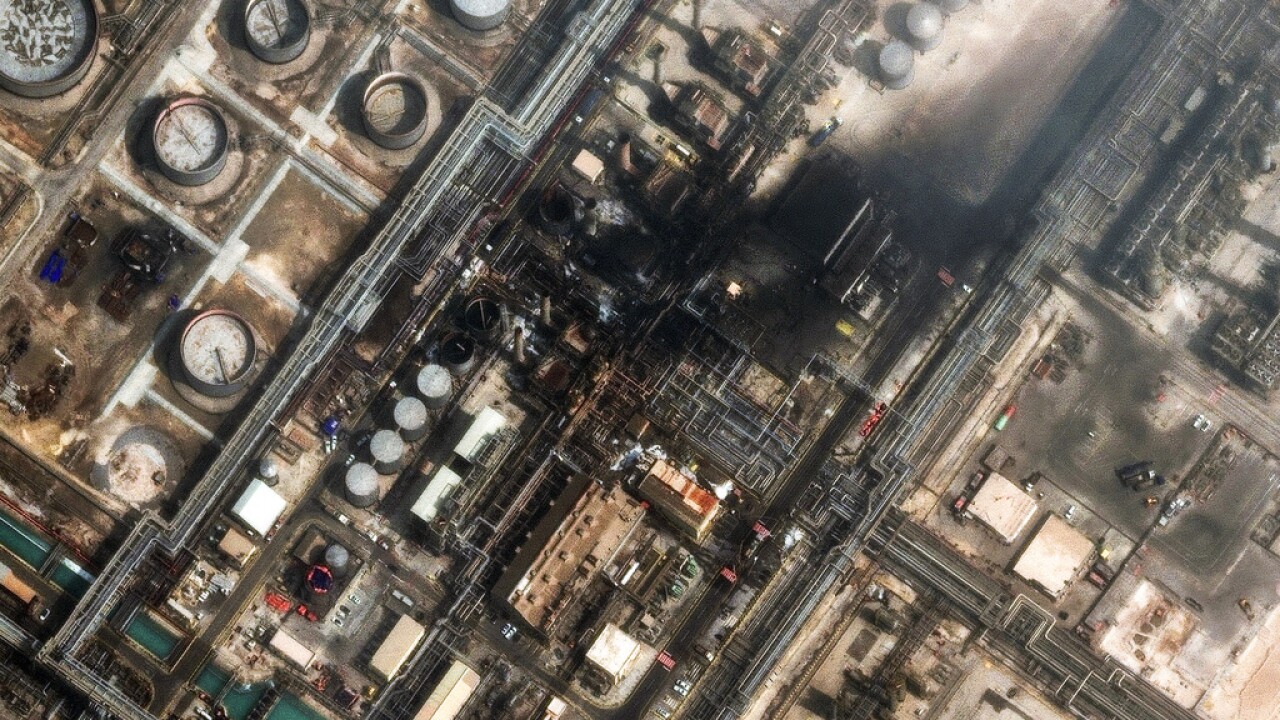


Iran struck the U.S. Embassy in Riyadh, Saudi Arabia, with drones early Tuesday as the widening Middle East conflict spreads across the region. The attack caused minor damage and a small fire. No injuries were reported.
Separately, an Iranian drone started a fire near the U.S. Consulate building in Dubai, in the United Arab Emirates. All personnel were accounted for, Secretary of State Marco Rubio said Tuesday.
Israel and the United States pounded Iran's capital, Tehran, with strikes Monday as the war expands to multiple fronts. An Iranian broadcast facility was hit in the latest round of bombings, though no injuries were reported. Hundreds have reportedly died in Iran as the conflict escalates.
President Donald Trump says the U.S. military campaign against Iran could last more than a month. Secretary of State Marco Rubio indicated strikes by the U.S. will only intensify.
RELATED STORY | Trump’s Iran attack raises legal concerns among Democrats in Congress
"The hardest hits are yet to come from the U.S. military," Rubio said.
The Pentagon describes Operation Epic Fury as the largest regional concentration of American military power in a generation.
American service members killed
U.S. Central Command has confirmed six American service members have died in the conflict. In Israel, three teenagers — siblings — were also killed in an Iranian missile strike.
Students killed in airstrikes
Funerals began Tuesday in Tehran for dozens of young students killed in their classrooms during the first day of U.S.-Israeli strikes on Iran. Iranian officials say at least 168 students died when airstrikes hit an elementary school in the southern city of Manab on Saturday. Large crowds gathered in the city's main square, holding images of the girls who were killed. The school is located about 200 feet from an Iranian military base.
Iran's foreign minister shared an unconfirmed image of a mass grave, posting: "These are graves being dug for more than 160 innocent young girls who were killed in the U.S. Israeli bombing of a primary school."
At the United Nations Monday, officials acknowledged they are investigating the report.
"Our reality is clear. When conflicts erupt, children are among those most severely affected," Rosemary DiCarlo, United Nations Under-Secretary-General for Political and Peacebuilding Affairs, said.
Questions on Capitol Hill
Lawmakers on Capitol Hill have mounting questions about the president's authority to launch Operation Epic Fury. Many Democrats believe the president did not seek proper authorization before launching the operation. Republicans have largely dismissed that argument.
Democratic Senate leader Chuck Schumer weighed in on the conflict.
"Donald Trump has just launched America into a full-scale conflict against one of our most fervent adversaries without a plan, without an end game, and without authorization for Congress or even a debate," Schumer said.
RELATED STORY | ‘This was our last best chance to strike’: Trump defends action against Iran
Speaker Mike Johnson pushed back on that characterization.
"It was not, it's not a declaration of war. It's not something that the president was required because it's defensive in nature and in design and necessity to come to Congress and get a vote first."
A War Powers Resolution vote is expected later this week on Capitol Hill, which could in theory restrict President Trump's ability to conduct operations. Given Republican leadership's position, that measure is expected to be defeated.
President Trump has given a conflicting timeline for the conflict, initially saying it could be over within days, then telling reporters it could last four to five weeks. Further escalation is expected in the coming hours.
Leadership vacuum in Iran
There is no update on who will lead Iran following the death of Supreme Leader Ali Khamenei. The question of succession is expected to have a significant impact on the direction of the conflict — whether Iran continues fighting to avenge Khamenei's death or whether new leadership pursues a diplomatic deal with the president.
Economic fallout
The conflict is already producing economic ripple effects. Roughly one-fifth of global oil consumption passes through the Strait of Hormuz, and there are conflicting reports about how much is currently able to move through the waterway. Iran has also reportedly targeted energy operations in Saudi Arabia and elsewhere in the region.
GasBuddy, which projects gas price changes in the U.S., is predicting a 30-cent increase in gas prices. Natural gas prices in Europe have also spiked.
The Trump administration says it is prepared to address the expected rise in gas prices, with plans that could include tapping into strategic reserves. The administration is also hoping that U.S. energy policy will help mitigate significant price hikes.
President Trump announced Tuesday the U.S. would provide political risk insurance for shipping traffic in the Persian Gulf.
He also said the U.S. may eventually provide escort security for oil tankers.
"If necessary, the United States Navy will begin escorting tankers through the Strait of Hormuz, as soon as possible. No matter what, the United States will ensure the FREE FLOW of ENERGY to the WORLD," the president wrote on social media.
Economic effects also reach beyond the energy sector. The price of sugar rose Tuesday amid concerns that countries like Brazil may shift production toward ethanol to offset rising gas prices, reducing the global sugar supply.
The U.S. State Department is advising Americans in the Middle East to leave a number of countries in the region. The warning was posted on social media Monday.
President Trump is expected to meet with the German chancellor Tuesday morning.


