

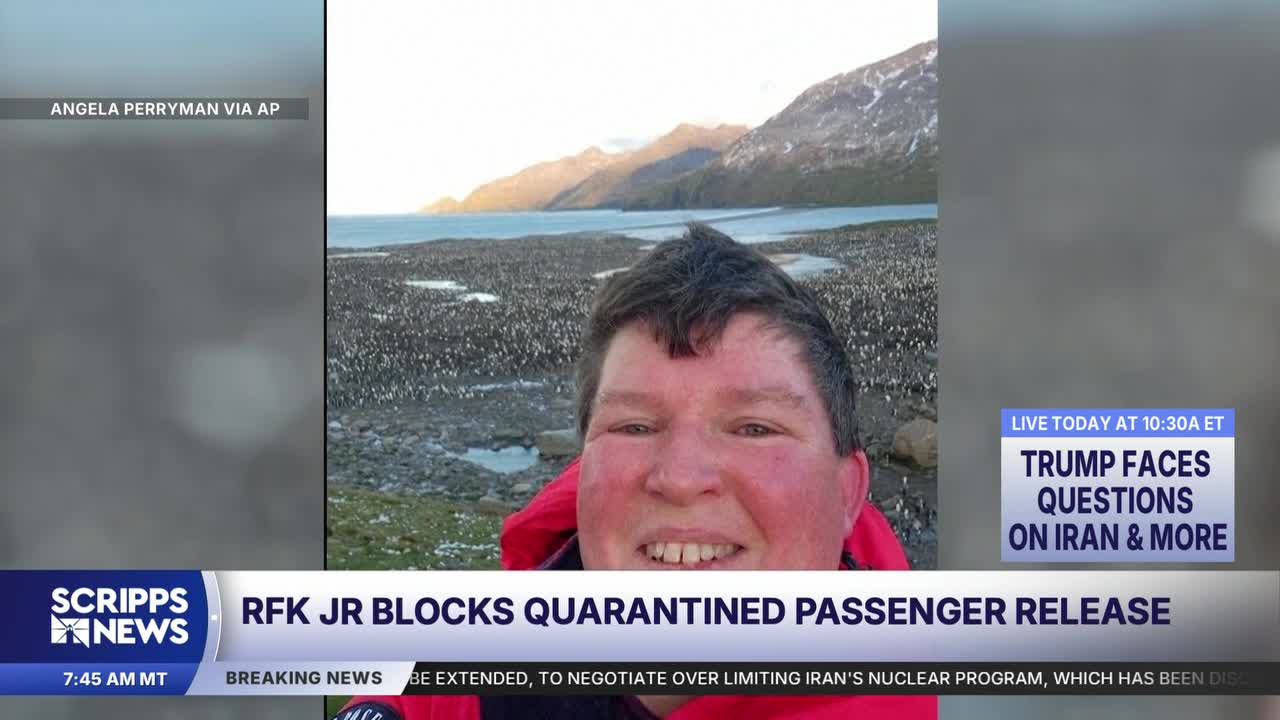


A woman who was exposed to hantavirus on the MV Hondius cruise has been ordered by US Health and Human Services Secretary Robert F. Kennedy Jr. to stay in federal quarantine, despite being cleared to return home to Florida by a federal health expert.
Angela Perryman says that she feels like she is “in prison” and that the health system has used her as “a prop and a political stunt.”
Perryman is one of 18 cruise passengers from the US who were sent to the National Quarantine Unit at Nebraska Medical Center in early May for medical monitoring after being exposed to a rare strain of hantavirus on board the ship.
RELATED STORY | US coordinating flight for Americans aboard hantavirus-stricken cruise ship
Some passengers have been willing to stay voluntarily for the entire 42-day quarantine period, but most have left the facility to continue quarantine at home. Passengers who departed were allowed to go if their state health departments agreed to conduct daily symptom monitoring and continuous 24/7 oversight of each person through June 21, and 10 have left.
But Perryman — who initially hoped to leave by June 1 — has not been able to go. Her home state of Florida has not agreed to the federal government’s monitoring requirements.
On Monday, Kennedy signed an order stating that the federal quarantine remains in effect for her.
“At this point, it’s just a state-federal spat, and I’m just a hostage,” Perryman, 47, told CNN.
RELATED STORY | 5 Americans released from quarantine after cruise ship hantavirus exposure
The initial federal quarantine period for Perryman was set to end May 31, but it was later extended by the US Centers for Disease Control and Prevention through June 21.
Perryman requested a medical review of the extended quarantine order, which was led by Dr. Michael Bell, a quarantine medical reviewer with the CDC. Expert testimony was provided by Dr. Christopher Braden, acting director of the CDC’s National Center for Emerging and Zoonotic Infectious Disease, and Dr. David Fitter, director of the agency’s Division of Global Migration Health.
In a report last week, Bell concluded that the federal quarantine order should be rescinded so Perryman could return home for the remainder of the 42-day quarantine period, as long as the Florida Department of Health “agrees to accept responsibility” for her public health monitoring and has a plan in place for hospital care if the need arises.
Instead of the federal government’s requirements for continuous monitoring, Florida proposed once-daily telehealth monitoring. And Bell said this would meet the intent of the quarantine order, which was to ensure that the public is not exposed to someone who may be infectious.
“In my professional judgment, this less restrictive alternative is adequate to protect public health,” Bell wrote.
“The testimony at the medical hearing persuaded me that measures CDC is imposing on Ms. Perryman are not the least restrictive available and that CDC should allow Ms. Perryman to complete her monitoring period at home subject to alternative restrictions.”
On Monday, Kennedy disagreed.
“Having considered the medical reviewer’s findings and recommendation and the evidence in the administrative record, I find that the requirements for Federal quarantine continue to be met,” Kennedy wrote in the order, and “continuation of the order is necessary to protect public health.”
Kennedy’s order did not respond to any of the detail outlined in Bell’s nine-page report.
“Secretary Kennedy specifically considered the medical recommendation before deciding to continue the current order consistent with [Acting CDC Director Dr. Jay Bhattacharya],” HHS spokesperson Courtney Spencer said in a statement to CNN. “In the absence of proper home monitoring by state authorities, the Administration’s quarantine order is necessary to ensure both Ms. Perryman’s and her community’s wellbeing.”
Nebraska Medical said that any questions about quarantine orders should go to the CDC, and the Florida Department of Health has not responded to CNN’s request for comment.
Perryman says she has completely lost trust in doctors, public health and the CDC because there have been too many rescinded promises.
“If it had been from the beginning that ‘this is the reason that we need to do this, and there is an actual scientific justification,’ then that would have been OK,” she said. “If there was a scientific reason for this, if I could see that, yes, this actually does further public health, I would have agreed.”
Perryman says Dr. Michael Wadman, medical director of the quarantine unit at Nebraska Medical, promised her that she would be able to return home after a few weeks of voluntary quarantine.
“He appealed to our citizenship, our desire to protect the community, our goodwill, basically,” she said.
Perryman spent $4,000 to rent a house in Florida for a month so she would have a place to stay that was completely private and away from others while she finished the end of the quarantine period, she says.
Nebraska Medicine says the quarantine unit team shared the information that they believed was accurate based on the information they had at the time of the initial quarantine order.
“But the federal agencies still needed to coordinate with the home states, so the logistics of those discussions would need to be confirmed through them,” a media relations coordinator said in an email.
When Wadman came to deliver the news about Kennedy’s order on Monday, Perryman said, she asked him to slip the paper under her door. She didn’t want to talk with him.
“We are not patients. We are just detainees, which is a much lower level of responsibility,” she said.
At the quarantine unit in Nebraska, staff stop by in full personal protective equipment to check their temperatures twice a day and deliver meals, she says. She gets about an hour of outside time each day.
“I can check my temperature in a living room just as easily as I can check my temperature in whatever you call this room,” Perryman said. “It’s like solitary confinement.”
The-CNN-Wire™ & © 2026 Cable News Network, Inc., a Warner Bros. Discovery Company. All rights reserved.


