

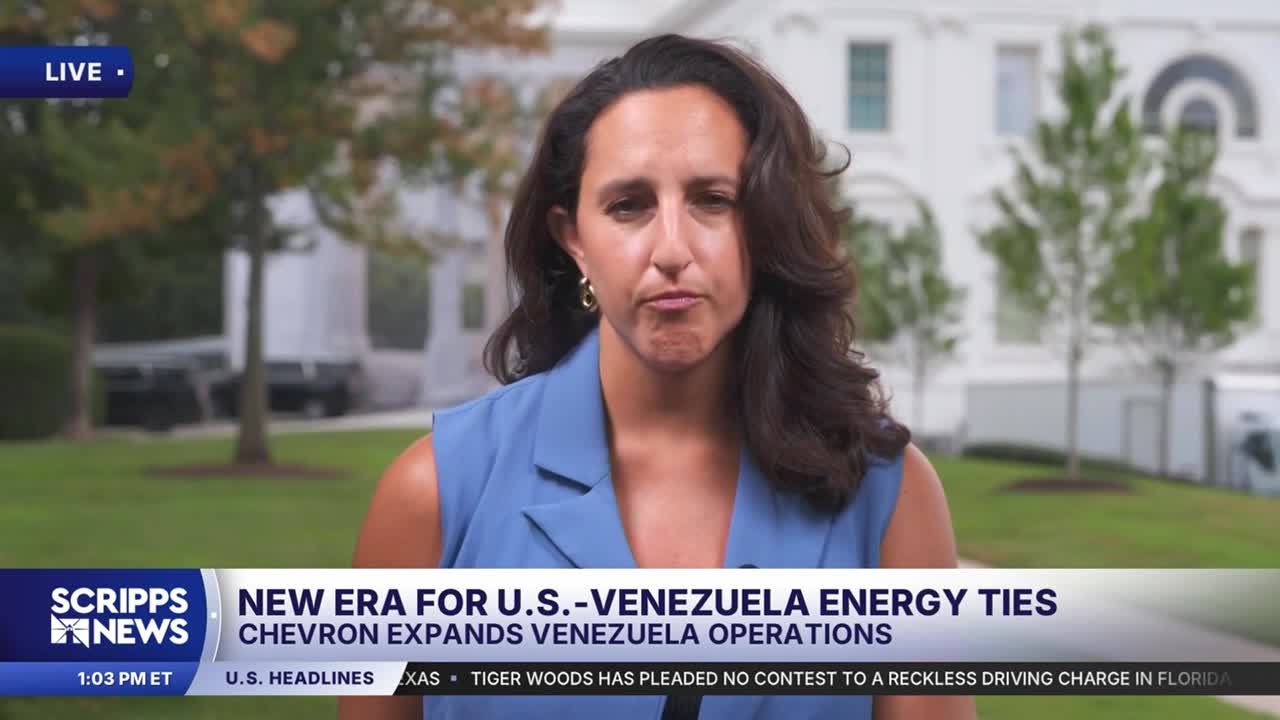


The U.S. and Venezuela are moving forward with efforts to expand energy deals, on the heels of an agreement allowing the U.S. to tap into Venezuelan oil, with aims of boosting the country’s oil production.
Chevron and Eni, both already operating in Venezuela, were among them.
The Department of Energy expects the agreements to more than double Venezuela’s oil production in less than five years, according to a spokesperson.
U.S. Energy Secretary Chris Wright met with acting Venezuelan President Delcy Rodriguez Wednesday in the country as the pacts across oil, gas and electricity were inked.
"The catalyst for transforming Venezuela is energy. The catalyst for improving the life conditions of Americans, our hemisphere, and everyone in the world is to massively expand energy production around the world,” Wright said. “But of course, we're massively interested in doing that in the Americas. This is our neighborhood, from Argentina to Canada, United States, Venezuela, Guyana, and Colombia; there are energy powerhouses in this hemisphere. And if we can replace the conflict of the past with commerce of today and of the future, we can build a better world."
Chevron announced agreements with Venezuela to expand development, invest $7 billion over five years and more than double production to 600,000 barrels a day. An agreement with Eni expands its operational footprint with an agreement to develop an oil field containing around 35 billion barrels of oil. Additionally, the administration said GE Vernova also signed an agreement to modernize and expand Venezuela’s electric grid.
“Chevron’s history in Venezuela spans more than a century, and our expanded position reflects our confidence in the country’s deep resource potential and its ability to compete for investment within our portfolio for decades,” said Mike Wirth, Chevron Chairman and Chief Executive Officer, in a prepared statement.
RELATED STORY | Trump announces deal to secure billions of barrels of Venezuelan oil for the US
It comes after the White House announced an agreement with Venezuela to give the U.S. government majority control of more than 65 billion barrels of oil reserves.
The deal between the U.S. and North American Blue Energy Partners, given 100 year concessions for 17 oil fields by Venezuela, allows the Pentagon to maintain an equity stake in the company and the state department a purchase guarantee of 20 percent production at cost and a right of first refusal for the rest.
“It was an opportunity, a geopolitical opportunity, to secure fields that primarily had largely been under the influence of Chinese and Russian companies, and allow them to instead be aligned with the United States and to our long-term interest,” said a U.S. official.
President Trump said he intends to refill the strategic reserve through the deal and claimed it “will substantially lower Gas Prices for all Americans, long into the future,” in a post on Truth Social.
However, some analysts are cautioning about the timeline.
“A lot of the oil covered by this agreement is very heavy, almost like solid, sticky oil. It's difficult to produce and transport. So if that's the oil they're focused on, it's gonna take a while to get the infrastructure in place to export a lot more of that,” said Samantha Gross, the director of the Energy Security and Climate Initiative and a fellow in Foreign Policy at The Brookings Institution.
Some analysts warned it could take time to refill the reserve, and expressed skepticism if it translates to cost savings for Americans, at least any time soon, noting the state of Venezuela’s infrastructure.
“This deal in the years ahead is absolutely very monumental and very significant, subject to legal risks and potentially regime shift in Venezuela, but it will not have major impacts on what consumers are paying anytime soon,” said Patrick De Haan, the head of petroleum analysis at GasBuddy.
“I think, in financial terms, it's a good deal for the U.S. government because you know it allows the State Department to buy oil at cost, and that's you know that's something I'm not quite sure what the United States State Department is going to do with that with the oil at that point, except for to boost strategic reserves at home,” said Duncan Wood, a fellow with the Wilson Center. “So that could produce some cost savings in terms of the fiscal bill for the United States. I see some good prospects there, but overall, I don't see this as a either a production or a oil trade deal that's going to significantly move international oil markets.”
However the administration expects a rapid scale up of oil flow.
“This is a company that already produces 250K barrels of oil a day. Because of the off-take rights, as soon as early next year, material production will be coming to the United States. By the end of the year, there will be at-cost oil flowing to the market to help bring down gas prices for the American people. It will rapidly scale over the next year,” said a White House official.
RELATED NEWS | Trump meets with oil executives at White House in push to lower gas prices
It comes as the White House has focused on cutting costs at the pump for Americans. Trump met with refiners and distributors at the White House Tuesday to discuss ways to expand US refining capacity, according to an official. The national average for gasoline has remained above $4 a gallon this week and the price of crude oil topped $90 a barrel amidst conflicts between the U.S. and Iran and Russia and Ukraine.
But some experts also question the endurance of the deal beyond current administrations.
“I think the key thing to it is the U.S. has never gone in, and the U.S. government taken an equity stake in oil production,” said Samantha Gross, the director of the Energy Security and Climate Initiative and a fellow in Foreign Policy at The Brookings Institution. Gross added, “it's a shocking deal for Venezuelans, and this all belongs to them.”
Gross, underscoring the unprecedented nature of the deal, expects in Venezuela “in a different democratically elected government to undergo a ton of scrutiny.”
President Trump said Venezuela's elections that it is "just not going to be ready for it yet but soon, we look forward to doing it soon."
U.S. officials contend that the deal will help lead to “a prosperous Venezuela that then allows it to become a stable republic” and continue to focus on private investment.
"The mission is to bring peace, freedom, opportunity and prosperity to the people of Venezuela," Wright said when announcing Wednesday's deals.
“It’s very important to remember that this opportunity in Venezuela is going to be weighed against opportunity elsewhere in the world, and if there are better opportunities for the capital that's available to big and small oil companies, for example, here in the United States, where you have a much more stable regulatory and legal framework and legal certainty, then the money may well come here as opposed to going there,” Wood said.


