

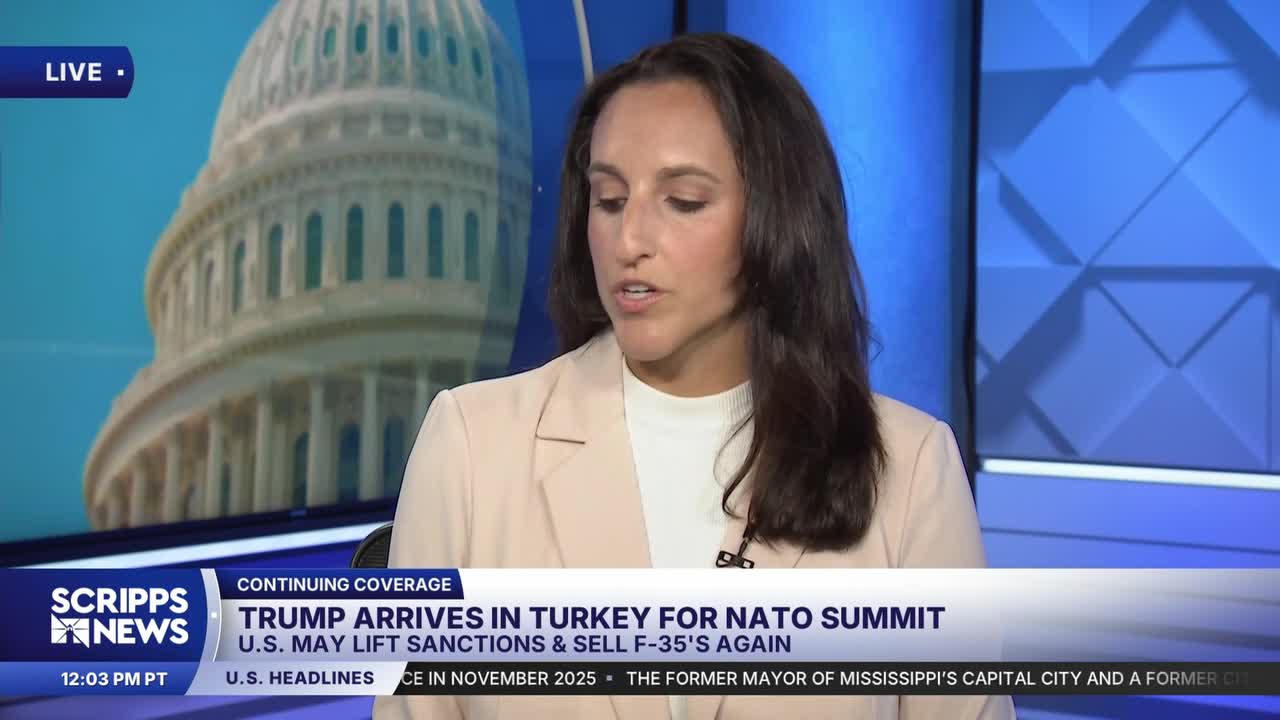


President Donald Trump arrived in Turkey for the NATO Leaders’ Summit Tuesday, where he praised the summit host while renewing disappointment in alliance members ahead of a summit expected to focus on defense commitments.
Trump was greeted by Turkey’s President Recep Erdogan — a Trump ally in the region with whom the president maintains a close relationship.
“Frankly, if it weren't held in Turkey, where my friend happens to be a very strong leader, a very strong person, it's possible that I wouldn't have attended,” Trump told reporters upon his arrival.
The summit comes as President Trump has criticized NATO not only for defense spending, at times raising questions about the US’ commitment to the Alliance, but also what he’s viewed as a lack of support for the US’ operations against Iran.
“I was testing to see whether or not they'd be there, because I'd wrong said that we helped them, but I'm not sure that they'd be there for us. And Italy turned us down, and Germany turned us down, and France turned us down, and it's okay, but you know, why are we spending hundreds of billions of dollars, and they're not there for us? We've always been there for them,” Trump said.
RELATED STORY | Trump says US will lift sanctions on Turkey, reopen door to F-35 talks
The summit is expected to focus on the delivery of defense commitments, after the alliance agreed to increase spending to 5 percent of members’ GDP’s, while the US has sought to shift the collective defense burden towards Europe as officials review the US force posture in Europe.
“The Ankara summit will measure progress against the Hague defense commitment and the 5% of GDP. we also will take stock of how allies are expanding NATO's core capabilities in support of the burden shifting going on here on the European continent,” said U.S. Ambassador to NATO Matthew Whitaker ahead of the summit.
Ahead of the summit, allies sought to showcase progress. NATO Secretary General Mark Rutte visited the Oval Office in late June, displaying charts of NATO spending progress he dubbed the “Trump Trillion,” heaping praise on the president and crediting him with increases in spending.
On Tuesday, the alliance showcased billions of dollars in procurements at the defense industry forum.
"We cannot continue as we did being over-reliant on the United States. We need this much stronger Europe in a stronger NATO, and we can only get there when we work together seamlessly as one, using and leveraging each other's strengths. And that's what we are doing,” Rutte said.
Some expect the alliance to “get down to business,” despite recent comments.
“I think they'll work through that, a lot of it's bluster, lots for the cameras and behind the scenes. I think they'll get to business,” said J.C. Lintzenich, a visiting senior fellow with the German Marshall Fund. He added that he viewed the US commitment to the alliance as “solid.”
“I think as the summit gets going, we'll see them get down to business of what the Secretary General has laid out. Where last year in The Hague, it was all about getting the commitments. This year it is, how are we going to take those commitments and move forward? Because throwing money at the issue is great, but we got to make sure we have the defense industrial capacity and the execution within European capitals to do that,” said Lintzenich. “So I think that's where the secretary general, where behind the bluster the administration wants to go, so this is a way for them to look at implementation moving forward.”
RELATED STORY | US revokes Iran oil sanctions waiver after alleged attack on vessels near Strait of Hormuz
Meanwhile, looming large over the summit are conflicts in Iran and Ukraine.
“So, those are two great powers, if you will, that we need to continue to contain with both from a US perspective, but as part of the alliance, it's something that NATO has to contend with as well,” said Lintzenich. “So, that factors in, but I think it factors in as the whole that NATO has to look at, which is a global issue at this point, when you count cyber, space, undersea cables, it's all becoming more interconnected than the alliance was originally envisioned to defend against.”
Officials expect the Strait of Hormuz to be a topic of discussion. Three tankers were struck in the waterway Tuesday according to the British military, and the U.S. revoked a license that allowed Iran to sell oil in response.
The U.S. on Tuesday also carried out new strikes against Iran in response, calling Iran's actions a "clear violation of the ceasefire."
Trump is also expected to meet with Ukrainian President Volodymyr Zelenskyy, after holding calls with Zelenskyy and Russian President Vladimir Putin over the weekend. Ukraine struck targets further into Russia, and Russia has carried out attacks against Kyiv, ahead of the summit.
“I think they both want to make a deal. It's too bad it took so long. Something's going to come out,” Trump said.
Officials expect Trump to meet with Zelenskyy and Syrian President Ahmed al-Sharaa Wednesday.


