

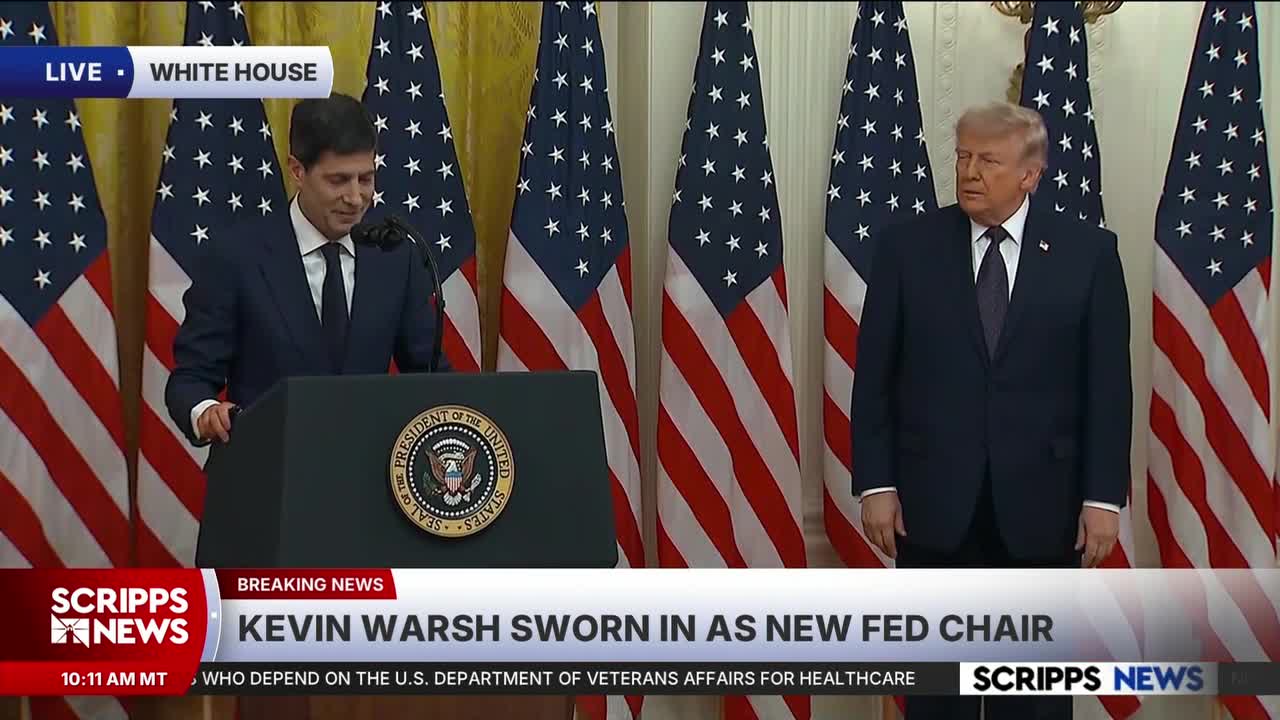


Kevin Warsh was sworn in as chairman of the Federal Reserve on Friday, replacing Jerome Powell.
Powell will remain on the Federal Reserve Board as a member — a rare move for outgoing chairs. His board term runs until 2028.
Warsh’s confirmation was less bipartisan than typical for incoming Fed chairs. He was confirmed 54-45, with only one Democrat voting in favor. By contrast, Powell’s 2018 confirmation as chair under President Donald Trump passed 84-13.
"I expect he will go down as one of the truly great chairmen of the Federal Reserve that we've ever had," Trump said. "I really believe that. I think he's got abilities that very few people have, covers a lot of territory, and he's respected by everybody. And that's so important in that position."
Powell’s tenure ended amid tensions with Trump, who repeatedly urged Powell and other board members to lower interest rates.
RELATED STORY | What will Kevin Warsh taking over at the Federal Reserve mean for consumers?
The Fed’s key role is setting the federal funds rate, which influences the rates banks charge each other for overnight loans and indirectly affects borrowing costs for mortgages, auto loans, credit cards, and businesses.
Low rates generally spur growth, but policymakers caution that keeping rates too low for too long can fuel inflation. After U.S. inflation topped 9% in 2022, the Fed raised rates to their highest levels in decades. Inflation fel to below 3%, though higher borrowing costs have slowed credit access and job growth. Since the Iran War began, inflation has crept over 3%, likely putting an end to any additional rate cuts for the foreseeable future. Powell has said the Fed’s aim is to balance low inflation with continued job gains.
RELATED STORY | Senate confirms Trump’s pick to replace Jerome Powell as Federal Reserve chair
Warsh, appointed to the board in 2006 by President George W. Bush, served as liaison to Wall Street during the 2008 financial crisis as the Fed implemented emergency liquidity programs for banks hit by subprime mortgage losses.
Before joining the board, Warsh was an economic adviser to Bush and executive secretary of the National Economic Council. More recently, he was a distinguished visiting fellow at Stanford University’s Hoover Institution and a vocal critic of Powell’s leadership at the Fed.


