

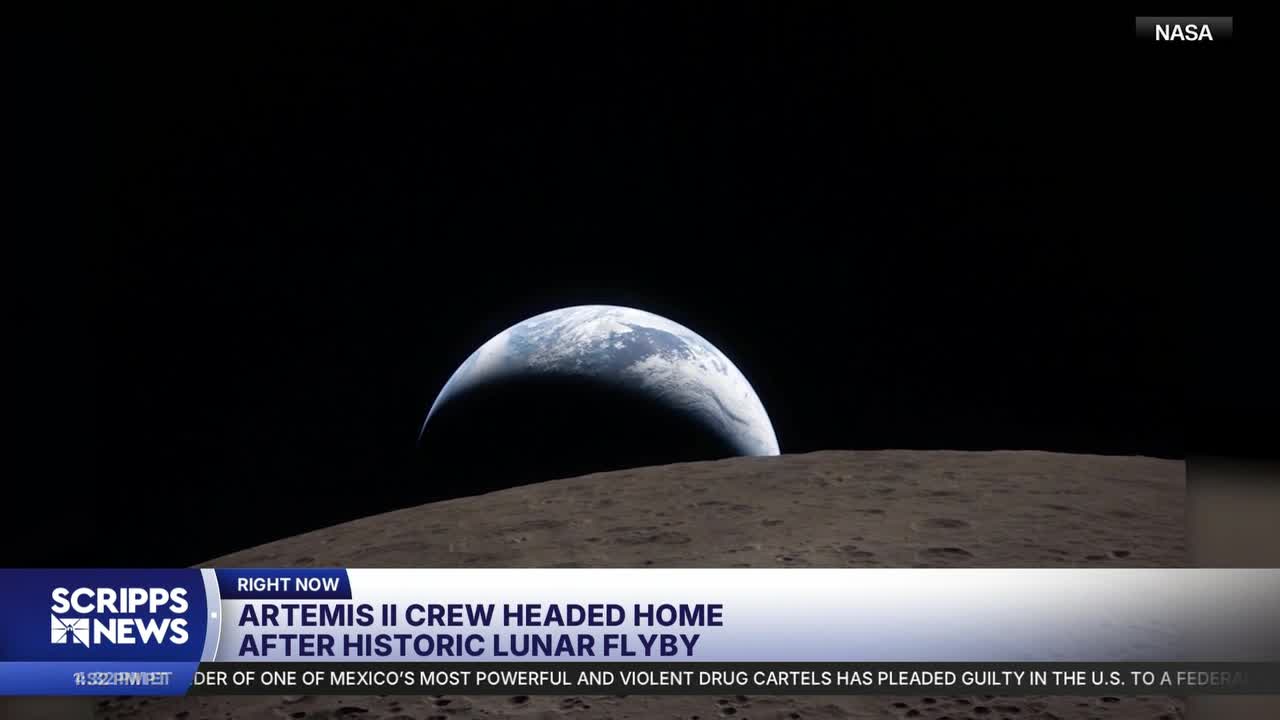


President Donald Trump spoke Monday to the four-member crew of Artemis II, hours after the three Americans and one Canadian completed a flyby of the moon.
The mission marked humanity’s first trip to the moon in more than 50 years and was the farthest humans have ever traveled from Earth. During the flyby, the crew recorded images of the moon never before captured by humans.
NASA designed the mission to test the Orion spacecraft’s life-support capabilities as it plans future missions to the moon and beyond.
“Today, you've made history and made all America really proud, incredibly proud,” Trump told the astronauts. "We'll plant our flag once again, and this time we won't just leave footprints. We will establish a permanent presence on the moon, and we'll push on to Mars. That will be very exciting. I'm waiting for that so much. I would love to be there, but maybe we won't quite make it in terms of timing. But we will be up on the moon.”
RELATED STORY | Artemis II mission completes successful transit around the far side of the moon
The astronauts described to Trump what they saw while orbiting the far side of the moon — the side that cannot be seen from Earth.
The call came just after the astronauts witnessed a solar eclipse, with Earth blocking the sun’s light.
“We saw sights — the Orientale (lunar sea) — sights that no human has ever seen before, not even in Apollo, and that was amazing for us,” Artemis II Commander Reid Weisman said. “And then the surprise of the day: we just came out of an eclipse. We could see the corona of the sun, and then we could see the planets line up and then Mars. All of us commented on how excited we are to watch this nation and this planet become a two-planet species."
During the flyby, astronauts lost contact with Earth for about 50 minutes, an expected outage as the spacecraft moved out of direct line of sight with Earth.
“I said a little prayer, but then I had to keep rolling,” pilot Victor Glover told Trump. “I was actually recording scientific observations of the far side of the moon. That’s the time when we were the farthest and the closest to the moon, so we were able to make some of our most detailed observations up close.”
RELATED STORY | What Artemis II astronauts eat: NASA space menu for moon mission
The Artemis II crew is now heading back to Earth aboard the Orion spacecraft and is scheduled to splash down off the coast of San Diego on Friday.


