

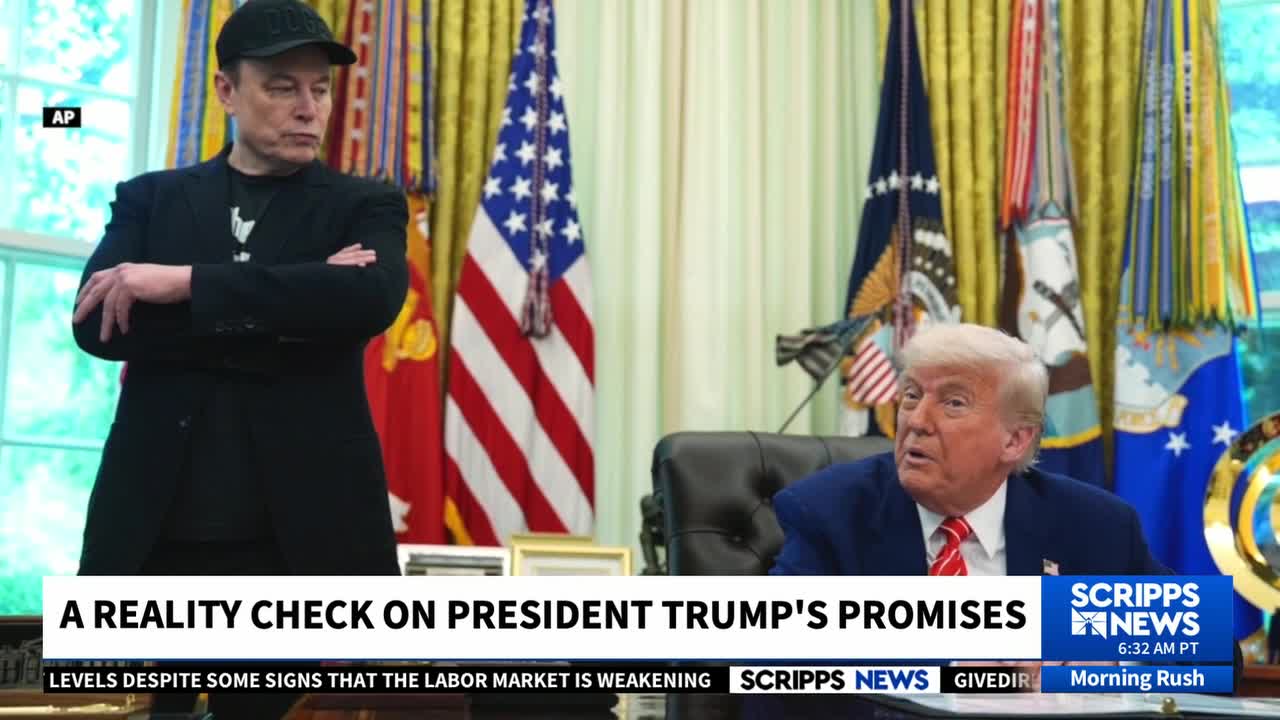


President Donald Trump began 2025 promising sweeping change. Nearly a year into his term, the results show a mix of achievements, setbacks and controversy.
One of Trump’s central pledges was to shrink the federal government. To lead that effort, he tapped Elon Musk, the Tesla founder, to head the newly created Department of Government Efficiency, known as DOGE.
Musk initially claimed the initiative would cut $2 trillion in federal spending. DOGE’s website now says it has saved taxpayers about $214 billion, a figure that has been disputed by multiple economists.
“DOGE didn’t cut, on net, a single penny of federal spending,” said Alex Nowrasteh of the Cato Institute, a Washington-based think tank. “Federal spending actually went up by $248 billion.”
Musk recently described the effort as “somewhat successful,” but said he would not take on the role again.
Securing the southern border was another major campaign promise. According to the Department of Homeland Security, illegal border crossings are down 93% year over year. The agency also says more than 2.5 million people who were in the country illegally have left amid the administration’s enforcement crackdown.
Trump’s deportation efforts, however, have drawn criticism. The Scripps News Group has documented allegations of expired food, undrinkable water and limited access to attorneys at some immigration detention facilities.
Immigration and the economy were widely seen as key factors in Trump’s election. Just like in other areas, assessments about the economy vary.
Gas prices have fallen, with the national average dropping below $3 a gallon for the first time in four years. Wall Street has also posted historic gains.
At the same time, unemployment has reached a four-year high, inflation has increased — with economists citing tariffs as a contributing factor — and economic confidence has fallen to a 17-month low, according to Gallup.
Restoring trust in government was also among Trump’s pledges. He has sought to do that by restructuring the Department of Justice and appointing public health officials who are pushing for vaccine reforms.
Still, controversial pardons, prosecutions of political rivals and the longest government shutdown in U.S. history have fueled public skepticism.
According to the Pew Research Center, just 17% of Americans say they trust the federal government to do what is right most of the time or always.


