

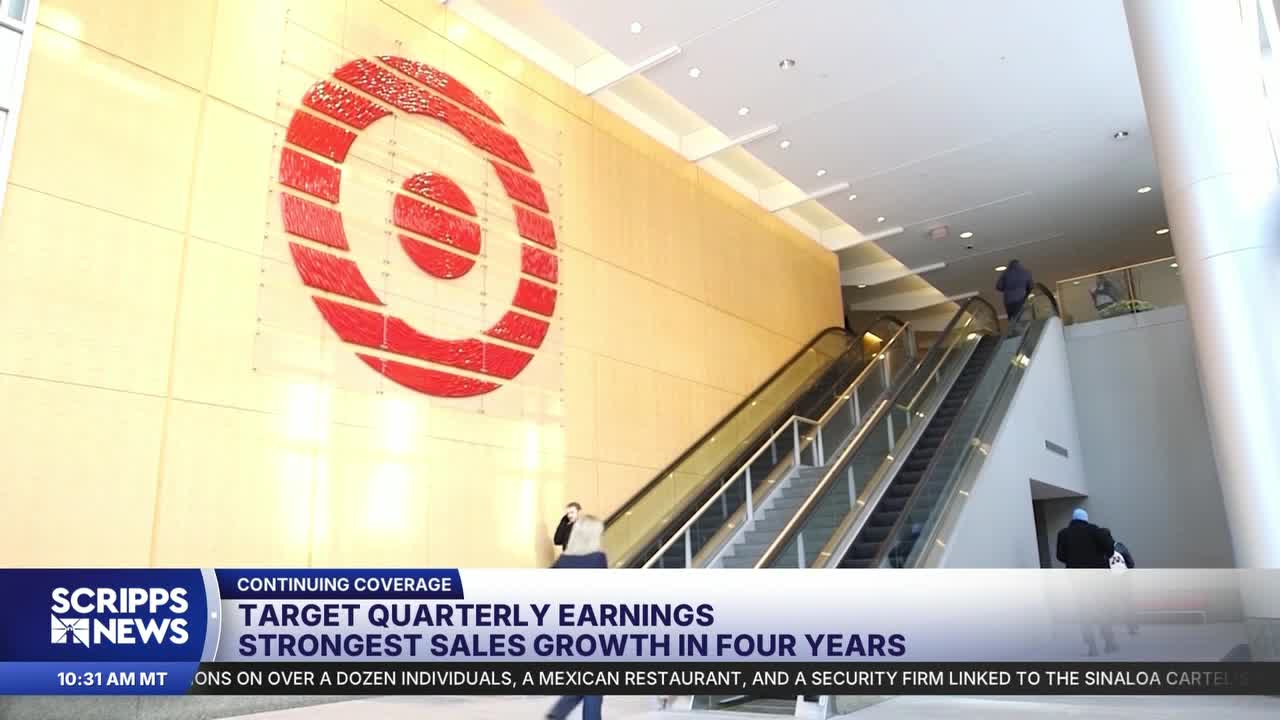


Target reported the largest jump in comparable sales in four years Wednesday, but a cautious outlook overshadowed convincing evidence that changes under the company's new CEO are resonating with customers.
Customers spent money across all of Target’s main merchandising categories and helped deliver better-than-expected sales. Comparable sales — those coming from stores and digital channels operating for at least 12 months, rose 5.6% in the three-month period ended May 2. It was the biggest gain since early 2022, and the first positive read after three consecutive quarters of negative comparable sales.
Target raised its annual revenue outlook, saying it expected momentum to continue the rest of the year. Yet the upgraded sales expectations were still below the pace of the first quarter and investors reacted negatively.
RELATED STORY | From Target to Kroger: The race to win over value-driven shoppers
Shares fell 5% Wednesday.
CEO Michael Fiddelke, a 20-year company veteran who took over in February, said he remained guardedly optimistic given where the company is in its operational overhaul.
“We’re encouraged to see a strong guest response so far,” Fiddelke said, adding: “We’re maintaining a cautious outlook given the work we know we have in front of us and ongoing uncertainty in the macroeconomic environment.”
In March, Fiddelke unveiled a $6 billion plan to reverse three straight years of sales declines. Target said it would remodel stores as part of an attempt to reclaim its reputation for stylish clothing on a budget, while it improved staffing and worker training.
New collaborations with labels like Roller Rabbit, an apparel and home goods brand known for its whimsical, block-print designs, resonated with shoppers, according to Target.
RELATED STORY | Target and Ulta Beauty are ending their store partnership
Target is one of the first big retailers to report financial results and industry analysts are watching closely to determine whether surging gasoline prices due to the Iran war have altered consumer behavior.
The chain was struggling long before the U.S. and Iran attacked Iran in February, however. Customers complained of disheveled stores that lacked the fashionable yet affordable niche that had earned Target the nickname “Tarzhay.”
Fiddelke reshuffled the leadership team at Target and on Tuesday, Target named a former Walmart executive as its new head of supply chain, another problematic area.
Some of Target's problems were self-inflicted. Its decision to roll back diversity, equity and inclusion initiatives led to protests and boycotts. And this winter, Target stores became another flashpoint with a federal immigration crackdown in its own hometown of Minneapolis.
Fiddelke acknowledged in an interview with The Associated Press in early March that boycotts had taken a toll, but said this week that increased store traffic in the first quarter was broad-based. He noted that more shoppers are picking Target more often, and “that’s a positive sign.”
Analysts, however, say Target's first-quarter performance offers a positive sign for the company.
Neil Saunders, managing director of GlobalData Retail, wrote that the results “represent an early win for Michael Fiddelke and his team.”
Saunders believes Target's lackluster sales had more to do with failing on execution than being caught up in cultural crosshairs like DEI.
“As important as that matter is, and as much as it does have some impact, it has never been the main issue,” Saunders wrote.
Target posted first-quarter earnings of $781 million, or $1.71 per share, for the three-month period ended May 2. That easily topped the $1.47 per share that analysts had expected, according to FactSet, but it was down from $1.04 billion during the same time last year.
Net sales rose 6.7% to $25.44 billion, also topping expectations.
For the full year, Target said it expected earnings per share near the high end of $7.50 to $8.50, the guidance it offered in March. Analysts are expecting $8.12 per share for the year, according to FactSet.
Target said it now expects net sales growth to be up 4% for the year, up from the previous forecast of 2%. That would bring sales to $108.97 billion.


