

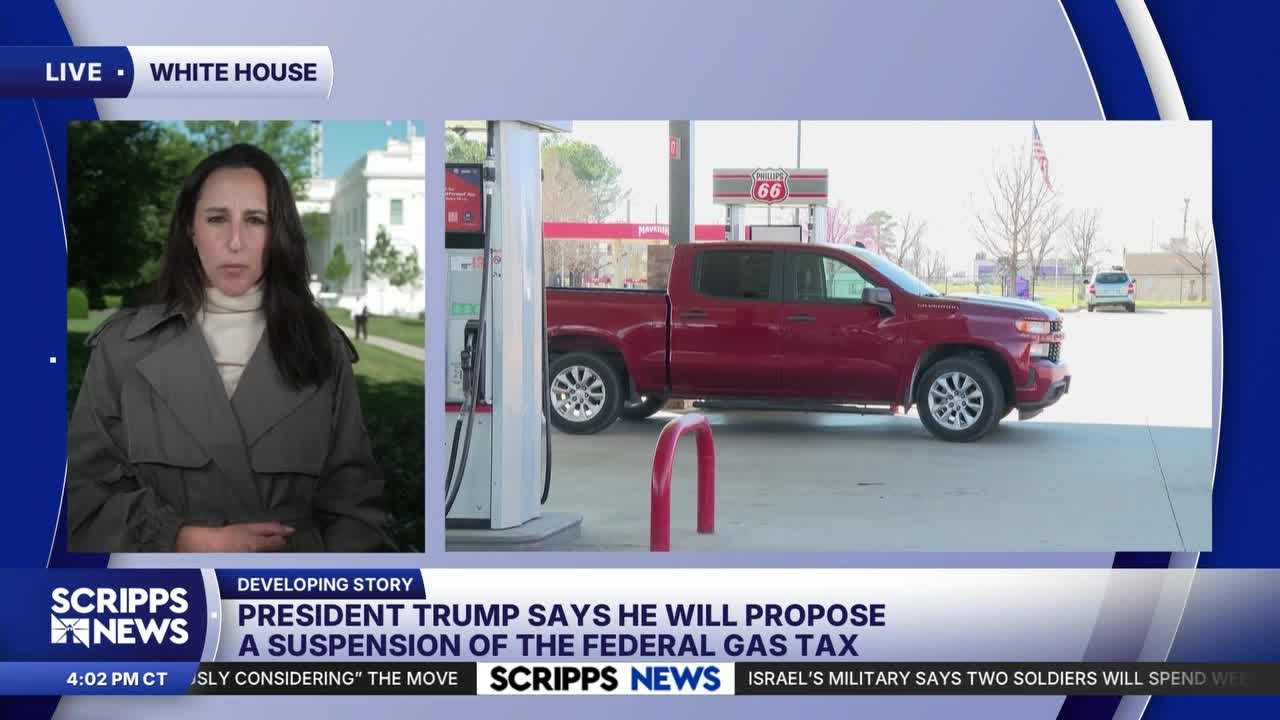


As the Iran war continues to force oil and gas prices to record highs, President Donald Trump on Monday voiced support for a temporary holiday on the federal gas tax to help ease consumers’ costs at the pump.
Speaking to reporters in the Oval Office, Trump proposed pausing the federal excise tax on gasoline, currently set at 18.4 cents per gallon, “until it’s appropriate.” The president went on to acknowledge such a move would have a limited impact, though he argued it would still benefit Americans.
“It's a small percentage, but it's still money,” Trump said.
Any change in the gas tax would require Congressional approval, as the legislative branch has authority over tax policy. And though some lawmakers on both sides of the aisle have voiced support for a gas tax holiday, Congressional leaders have thus far thrown cold water on the idea.
Moreover, a pause on gas tax collection is likely to have limited impacts for consumers but significant impacts on federal budgets, experts tell Scripps News. They say there are only two ways to bring down gas costs significantly: lower demand, something unlikely to occur ahead of the summer travel season, or boost supply.
“There are a variety of ways to nibble around the edges, but addressing the root problem here is really a foreign policy question,” Carl Davis, research director at the Institute on Taxation and Economic Policy, told Scripps News. “There is no quick fix — you can't slap a band-aid on this problem, as tempting as it is.”
What is the gas tax?
Taxes on gasoline are part of a category of government levies known as excise taxes. In short, these fees are imposed by the government on specific goods, services, or activities, and are often designed to raise revenue or discourage consumption.
A number of different products and services are subject to excise taxes, including tobacco, alcohol, and airline tickets, for example. Unlike general sales taxes, excise taxes are typically imposed on manufacturers or sellers, with some portion of the cost then passed down to consumers.
According to the U.S. Energy Information Administration, a semi-independent federal agency within the Department of Energy that provides data about energy production and costs, every U.S. state imposes its own state gas tax on consumers, in addition to the tax imposed at the federal level.
The amount of those taxes varies by state: California’s 70.9 cents-per-gallon rate is currently the highest in the country, while Alaska’s nine cents-per-gallon rate is the lowest. And that's all before the 18.4-cent-per-gallon federal gas tax all U.S. consumers face.
Diesel fuel faces an even higher tax rate of 24.3 cents per gallon federally, as it’s used by heavier trucks that wear more significantly on roads and highways.
What do governments use gas taxes for?
Most states and the federal government use gas tax revenues to cover transportation expenses, such as the cost of maintaining roads and highways. The federal gas tax is the main funding mechanism for the Highway Trust Fund (HTF) — the primary funding source of the U.S. highway and mass transit projects, including the interstate highway system.
Yet at both the state and federal levels, gas tax revenues typically fall short of the true cost of transportation expenses, forcing governments to either take on debt or move tax revenues from elsewhere to cover excess costs.
“With the gas tax where it is currently set, that Federal Highway Trust Fund is underfunded: It is not receiving enough revenue to cover all the expenses that the federal government wants to spend on transportation,” said Adam Hoffer, director of excise tax policy at the Tax Foundation.
A federal gas tax holiday would exacerbate such problems: Davis’s group estimates a federal gas tax holiday would reduce revenues by $2.4 billion per month, and an analysis released last month by researchers with the Bipartisan Policy Center projects a five-month gas tax holiday would reduce federal revenues by nearly $17 billion.
“It creates a real fiscal problem almost immediately, and that problem would only grow the longer that the gas tax holiday was in place,” Hoffer said.
Can Trump suspend the gas tax unilaterally?
In short, no. According to the U.S. Constitution, federal tax and spending authorities – the so-called “powers of the purse” — sit with Congress. The president is free to make proposals to lawmakers for specific tax programs and sign bills into law once they pass both chambers, but it’s ultimately the legislative branch’s role to set tax rates.
Yet the Trump administration, especially since the start of the president’s second term, has repeatedly sought to expand the executive branch’s authorities. As such, experts who spoke to Scripps News have been hesitant to declare definitively that Trump cannot act unilaterally, though most agreed such a move was unlikely.
“Clearly, this is something that Congress has the authority to do,” Davis said, though he noted the Trump administration “has been pushing the boundaries of what it's allowed to do to our tax code unilaterally.”
“A year or two ago, we would have said that tariffs being issued by the executive branch would not have been something that we expected. We would have thought that that was a congressional process,” echoed Hoffer.
Asked repeatedly how Trump intended to pursue a gas tax holiday, the White House declined to comment, deferring to the president’s earlier statements.
What impact would a gas tax holiday have on consumers?
According to energy and tax policy experts, a temporary pause in gas tax collection would have a limited impact on bringing down consumers’ prices for several reasons.
Primarily, that’s because the tax itself is relatively minimal – about 18 cents per gallon at the federal level. So even if the tax were suspended tomorrow and those savings were passed fully onto consumers, that would do little to offset the significant increases in gas costs brought on by the Iran conflict.
A gallon of regular, unleaded gas costs an average of $4.52 per gallon in U.S. gas stations on Monday, according to AAA, up more than $1.50 since the Iran war began. An 18-cent savings would help some, but nowhere near enough for the Americans struggling to afford fuel.
Moreover, because the gas tax is imposed on fuel producers and wholesalers, only a portion of those savings is likely to be passed down to consumers, just as only a portion of tax increases are passed to consumers when rates are hiked.
A 2022 study in the journal Energy Economics estimated gas tax suspensions would pass through to consumers by about 79%; so an 18-cent holiday would only offset consumers' costs by about 14 cents.
Some states, including Georgia, Utah and Indiana, have already taken steps to suspend their state gas taxes, though such measures have similar pitfalls: minimal impact on consumers but significant impact on state budgets.
“You're cutting taxes at the wholesale level and then crossing your fingers and hoping that that tax cut finds its way to drivers at the pump,” Davis said of gas tax holidays. “There's no guarantees that the full tax cut is actually going to get to drivers.”
What does Congress think?
Like most taxes, gas taxes are broadly unpopular. As such, some lawmakers of both parties have supported gas tax suspensions – both historically and today.
Earlier this year, Sens. Mark Kelly (D-AZ) and Richard Blumenthal (D-CT) introduced a bill to implement a gas tax holiday through Oct. 1. On Monday, in the wake of Trump’s announcement, Sen. Josh Halwey (R-MO) announced that he’d introduce his own measure.
Yet lawmakers have historically been hesitant to follow through on such proposals; similar measures introduced in the wake of the 2008 financial crisis and the 2022 Ukraine conflict both failed to materialize.
On Monday, Senate Majority Leader John Thune (R-SD) threw cold water on the idea of Congress acting on the gas tax, though he suggested he’d explore Trump’s proposal.
“I’ve not in the past obviously been a fan of that idea,” Thune told reporters. “But, you know, I’ve got some colleagues out there who think it’s a good idea, and so we’ll hear them out.”
The Majority Leader went on to say he preferred a more permanent solution, like reopening the Strait of Hormuz to the global oil trade.
Meanwhile, experts noted that any gas tax holiday would likely have to be paired with a different tax hike down the line – meaning consumers would pay the price one way or another.
“While we know gas taxes are unpopular, so are just about every other form of tax,” Hoffer said. “If you need to fund transportation via some other tax source, this is really an example where there is not necessarily going to be a popular solution for how to address this issue.”


