
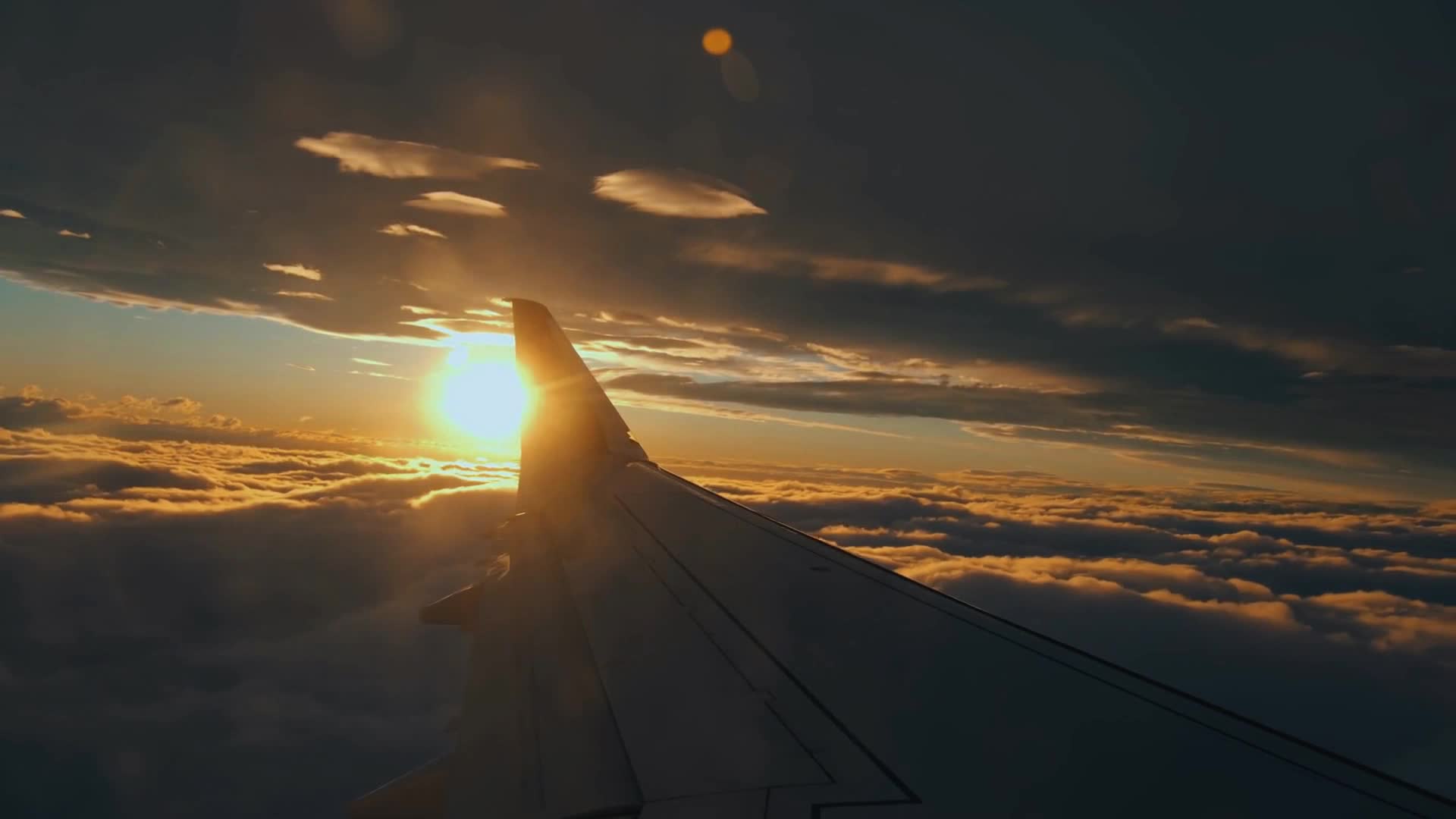


Estimate your cosmic radiation dose during a flight HERE.
For nearly three decades, 52-year-old Sara Nelson has been exposed to radiation every time she goes to work — a risk shared by hundreds of thousands of her fellow aircrew members, many of whom say they were never told an alluring career in flying would regularly expose them to a known health hazard.
Flight attendants like Nelson spend hundreds of hours a year at cruising altitude, where Earth’s atmosphere thins and they are exposed to high-energy radiation from space — known as cosmic radiation — in which the CDC says passengers and aircrew are exposed to “on every flight.” Other federal officials say regular workplace exposure to the naturally occurring radiation raises health risks.

“It’s very difficult with radiation because you can’t see it, you can’t smell it, you don’t know when it’s affected you,” Nelson said. “I went through seven weeks of flight attendant training. No one mentioned radiation to me.”
On the ground, the atmosphere acts as Earth’s protective bubble, shielding people from most of the cosmic radiation. At 35,000 feet, that protection weakens. And the higher you fly, the thinner that shield becomes.
A report from the National Academies of Sciences, Engineering and Medicine, published in 2006, “concludes that the preponderance of information indicates that there will be some risk, even at low doses."
Travelers typically receive a very low dose on each flight. But over the years, as a frequent flyer or through a career in the skies, regulators in many countries have taken note that those small doses can add up to create a larger cancer risk.
In much of Europe, regulators require airlines to protect flight crews. But no similar required protections from cosmic radiation exposure exist in the United States.
An investigation by the Howard Center for Investigative Journalism at Arizona State University found that despite decades of FAA-sponsored research documenting elevated cancer risks for flight crews and other health effects, the agency does not require radiation monitoring, annual exposure limits, route adjustments, or warnings to crew and travelers. The result is a regulatory void in which a known occupational health hazard remains largely unmanaged for hundreds of thousands of U.S. flight crew members and the public.
“We are an aviation safety agency and our regulations do not address radiation exposure,” an FAA spokesperson confirmed in an email.
Instead, the agency provides an Advisory Circular with nonbinding recommendations on how air carriers and crew members can manage their in-flight radiation exposure themselves.
The investigation found that:
- The FAA has known for decades that cosmic radiation at cruising altitude damages DNA and increases fatal cancer risk, but has never set rules requiring airlines to warn, monitor, or protect flight crews or passengers.
- FAA scientists have estimated that over a long flying career, some flight crews face a measurable increased risk of dying from cancer caused by on-the-job exposure to cosmic radiation.
- U.S. pilots and flight attendants are exposed to more occupational radiation than nuclear weapons producers and X-ray technicians — workers who are legally required to be trained, monitored and protected. Aircrews are not.
- Many European countries and South Korea require radiation monitoring and exposure limits for flight crews. The United States does not.
- During one of the strongest solar radiation storms in decades, many long-haul flights crossed through a region at higher risk for radiation exposure without rerouting, even after federal alerts warned radiation levels were elevated.
- The FAA has taken offline the only public tool that allows travelers and crews to easily estimate radiation exposure.
The lack of statutory protections does not sit well with Nelson.
“It feels very dismissive. It feels as though we're not just a line item on someone's cost sheet, but that we're actually disposable.”
Documented harm
The increased health risks of choosing a career in the air are well-established.
A 2018 Harvard study found that flight attendants have a higher rate of breast cancer than similar individuals in the general population.
While aircrew face multiple hazards, research has confirmed that repeated exposure to low doses of ionizing radiation (including cosmic radiation) increases their risk of death.
A 2021 FAA report concluded that aircrew flying the Athens, Greece to New York route for 25 years would absorb enough cosmic radiation to significantly increase their cancer risk, estimating that one out of every 190 exposed crew on this route could die from cancer due to this on-the-job radiation exposure.
Damage left by exposure to repeated in-flight cosmic radiation can linger in a family across generations. The same FAA report says a woman flying that Athens-to-New York route for just five years before conceiving a child faces a lower, but still measurable, increased risk that her child could be born with a genetic defect linked to the mother’s radiation exposure.

The FAA has known about the harm cosmic radiation can pose to pregnancies and children of flight crew members since at least 2003, when it published a study examining what aircrews should know about their occupational exposures.
“A child is at risk of inheriting genetic defects because of radiation received by the parents before the child’s conception,” the 2003 report from the FAA’s Office of Aerospace Medicine stated.
In July 2025 the Howard Center asked the American College of Obstetricians and Gynecologists (ACOG) why their "Travel During Pregnancy" FAQ page has no mention of radiation risks from flying, while elsewhere on their website they say that frequent fliers and aircrew can exceed recommended exposure limits.
Jamila Vernon, ACOG’s Senior Media Relations Manager explained via email that: “During the editorial review process for the FAQs, the question addressing frequent flyers was not considered a frequently asked question by patients according to the physicians on ACOG's committee. However, this information will likely be added in the near future to be in alignment with ACOG's pregnancy book.”
The "Travel During Pregnancy" FAQ page has been updated, and now states: “Radiation exposure increases at higher altitudes, but the level of exposure isn’t a concern for occasional travel. If you work on an airline crew or fly often, talk with your ob-gyn about how much flying is safe for you.”
Decades of research, yet zero rules
Flight crews are “among the most consistently highly exposed individuals” of any occupation in the U.S. – more than x-ray technicians and nuclear weapons makers, who are required by law to be trained, monitored and protected against high-energy radiation.

The FAA’s hands-off approach to installing required protections has put the U.S. behind many members of the E.U., the U.K., and South Korea, where the law requires airlines to train, monitor and protect aircrews against cosmic radiation. An E.U. directive requires that carriers track crews’ radiation dose on each flight to ensure no one exceeds mandated annual caps.
If they fail to do so, airlines could lose their license to fly.
Sara Nelson became a flight attendant around the same time European regulators began setting rules to protect air crews. Nelson said in the U.S., she does not recall ever being trained to protect herself. She said she did not become more informed until she became a union leader and began to learn from partners in other countries.

“It took me going to these international meetings with other workers around the world to understand how little we are told in the U.S. about the risks that we face,” Nelson said.
As early as the 1960s, the FAA brought together radiation experts from around the world to investigate cosmic radiation as a potential threat.
Recently retired pilot Joyce May said she has seen many other safety risks, once considered harmless, addressed since she took her first flight as a commercial pilot in the 1980s. For instance, smoking on board a plane is now illegal.
When May became aware of the real risks to pilots from cosmic radiation, she personally contacted the FAA to ask why the agency had left crews in the U.S. unprotected by regulation.
“I’ll never forget,” May said. “The response I got was, ‘Well, you have a union, don't you?’”

In 1990, the flight attendant union petitioned the FAA to adopt for airline crew members the same statutory protections OSHA has for radiation workers.
Seven years later, the request was denied.
“The FAA has determined that the issues identified in your petition may have merit but do not address an immediate safety concern,” wrote Ida Klepper from the FAA’s Office of Rulemaking, citing budgetary constraints, the demands of a changing industry and a complex air travel system.
Now, the former pilot says decades of radiation exposure are on her mind at a time she should be able to relax in retirement.

“You have this wonderful career that you've worked so hard at, that you're so proud of, that you don't want to then have to tie in this,” May said.
“I'm not a fan of big government regulation, but there are sometimes when it's necessary. And in my opinion, this is one of them,” she added.
Radiation spikes during solar flares and storms
Cosmic radiation doses can spike during solar flares and geomagnetic storms.
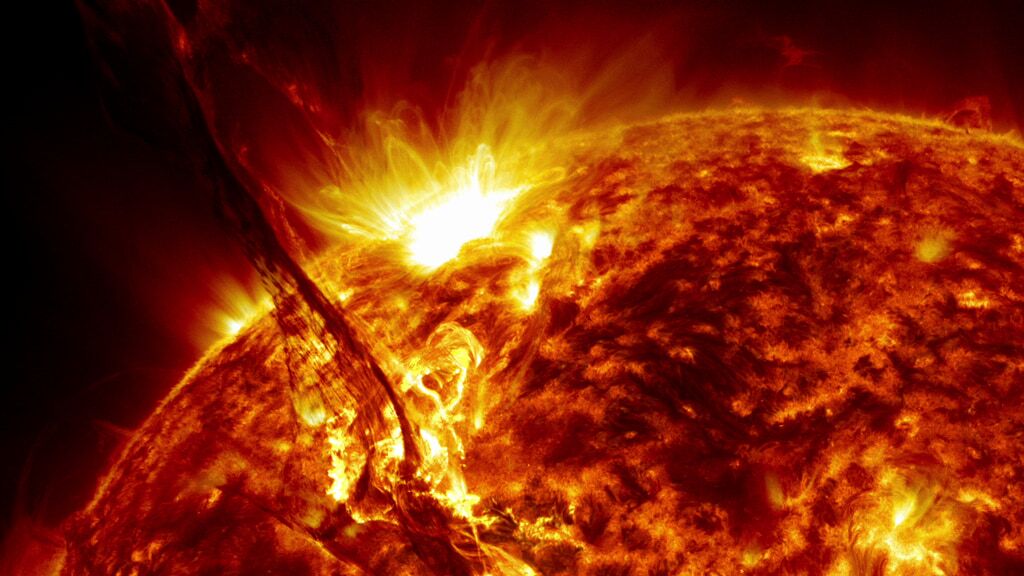
Just as airlines are not required to warn flyers or flight crews about standard exposures, they also have no requirements to inform them about increased radiation exposure during these events.
In May 2024, former NASA scientist Kent Tobiska was preparing to fly from San Francisco to Paris for a work conference. That morning, he checked alerts on an app his company created.
Bright reds and oranges lit up his screen. As it would turn out, Tobiska was about to fly through one of the strongest solar storms of the twenty-first century, later named the Gannon storm.
Aware of the rare scientific opportunity to document the increased risk to fliers, Tobiska decided to pack his professional-grade $35,000 dosimeter — a radiation measurement device.
For the entire 11-hour flight, the device remained stowed in the overhead bin undisturbed, but relayed measurements. Tobiska sat in his seat, stunned, as he watched the tool’s measurements from the app on his phone.
“I kept nudging Susan in the seat next to me, my wife,” Tobiska said. “I said, ‘Wow, look at the radiation we’re getting on this flight.’”

Tobiska says the airline did tell him, only when he asked, that it intended to fly a different route than normal to attempt to mitigate impact from the space weather event. He says other passengers were not told about the solar storm until the plane was in the air.
But it could have been worse had the flight not changed course.
Instead of flying over northern Canada and Iceland – on a route close to the North Pole and through a region the FAA says has “the highest dose rates” from cosmic radiation – Tobiska’s flight took a path across the northern U.S. His flight also cruised at a lower altitude than normal.
That lower-latitude, lower-altitude route took more time – but likely reduced radiation exposure for everyone on board significantly.
Still, even after changing course, when Tobiska and his wife landed in Paris, his dosimeter measured a total dose equivalent to four standard chest X-rays’ worth of radiation — all in just one flight during the solar storm.

The airline did not have to modify its flight path. The FAA has no rules requiring airlines to change course to protect flyers from spikes of radiation during solar storms.
In 2008, the FAA barred flights from operating during a solar storm in the North Polar area, a region with elevated radiation levels, unless specifically authorized by the FAA.
Airlines seeking an exemption must have an FAA-approved plan, but the FAA does not define any requirements for how radiation exposure should be mitigated, set any exposure limits, or explain how an airline’s plan should be enforced.
When asked about several topics related to protecting aircrews on U.S. flights, an agency spokesperson said broadly the FAA does not regulate cosmic radiation.
Airlines don’t even have to act when they receive an alert from the federal government’s Space Weather Prediction Center, which runs an alert system for the National Oceanic and Atmospheric Administration (NOAA).
At the Boulder, Colorado-based office, federal forecasters use a network of satellites to monitor the sun’s radiation 24 hours a day, seven days a week.
“The airlines get the notice from us, and they can quickly drop in altitude,” said Shawn Dahl, a space weather forecaster for NOAA. “That will minimize entirely any dangerous radiation exposure. That’s why we do what we do here.”

The FAA rule also focuses on a narrow swath of the North Polar-latitude region, failing to require a plan to mitigate exposure in the much larger FAA Solar Radiation Alert Region 1, where the FAA says “the magnetic field provides little to no protection from solar cosmic radiation.” The region includes areas like Greenland, Iceland and much of Canada, Scandinavia and Russia.
The Howard Center analyzed 76 international flights on routes that typically fly through this region to see if they changed course during the Gannon storm, an event that took place across three days in May 2024. The analysis found that half of these flights traveled straight through the hotspot of radiation.
We asked 11 airlines why they did not reroute their flights. Seven did not respond. Both United and Japan Airlines promised statements that never came.
Virgin Atlantic said, “When planning the aircraft’s route and flight level, the safety and comfort of our customers and crew is always our top priority and is never compromised.”
American Airlines’ spokesperson Ethan Klapper told the Howard Center during big space weather events like last year’s Gannon storm, the airline does not fly planes through the “North Polar region.” Klapper added, “The North Polar region begins at 78 degrees north latitude,” an area he said American has not operated in since 2022.

But in an analysis of publicly available flight tracking data, the Howard Center found at least seven American Airlines flights still flew during that storm through the broader region that the FAA says has little to no protection from cosmic radiation.
American Airlines did not respond to follow-up questions about those specific flights.
Industry perspective, including solutions
A 2020 study co-authored by FAA scientist Kyle Copeland and German researchers estimated that dropping cruising altitudes from 41,000 feet to 29,000 feet, where the atmosphere is denser, could cut radiation exposure in half for everyone on board. Doing so, however, also increases the cost of fuel — perhaps by tons, because the atmosphere is denser at lower altitudes and creates more resistance for planes.
A paper published in the journal Space Weather crunched the numbers for a flight from Tokyo to London with 80% occupancy and found that dropping 40,100 to 30,100 feet would burn through nine extra tons of fuel. If jet fuel is priced at $697 per ton, that move would cost an airline an added $6,000 on that one flight alone.
If the plane flies at the same altitude but farther from the poles, on a lower latitude line, it would have to travel a longer distance and need 28 more tons of fuel, costing airlines an extra $20,000 per flight.
The Howard Center sought comment for this story from Airlines for America (A4A), the primary trade group representing leading U.S. airlines like American Airlines, Delta, Southwest and United, as well as cargo carriers like FedEx and UPS.
The group declined an interview.
But the Howard Center found a 2019 legal memo signed by the trade group and its global counterpart, the International Air Transport Association (IATA), arguing that the FAA should tone down its official guidance to airlines about the risks of cosmic radiation, which comes in what the FAA calls an Advisory Circular (AC) titled “In-Flight Radiation Exposure.”
The circular – which describes cosmic radiation and its health risks, including cancer – discusses how space weather events can increase doses, and offers a list of further reading material for interested parties. The circular also presents dose estimates for 27 flight routes, and it recommends annual dose limits for aviation workers and strict dose caps for pregnant cabin crew, while providing guidance on how crew members can calculate their own doses.

The 2019 letter from the two industry trade groups says if the FAA did not amend or withdraw some of its voluntary guidance, carriers that did not implement recommendations “may face spurious claims of damage” as “claimants may use the wording of the AC to overstate the case.”
The FAA left its guidance unchanged but never wrote a rule requiring airlines to act.
Airlines for America did not address specific questions about its 2019 letter but issued a general written statement insisting “the safety of our passengers and crew members is the top priority for our carriers.”
The trade group also said it is participating in a current study by the National Academies of Sciences, Engineering and Medicine.
In 2024, Congress mandated the new study.
“It is a little bit absurd that we have to go through decades of advocacy just to get a study,” lamented union leader Sara Nelson.
At a June hearing before the House’s aviation subcommittee, Nelson told members of Congress the FAA had taken a calculator offline which is supposed to make it easy for aviation workers on their own to keep track of their radiation exposure using federal estimates of radiation doses.
“That link is currently not working. So we're going backwards instead of forwards,” she testified.

Seven months later, the link remains unavailable on the FAA website.
The FAA said it took the radiation exposure calculators offline to upgrade their infrastructure.
“We expect to return them to service in mid-2026,” said FAA spokesperson Ian Gregor. “In the meantime, people can still use the downloadable versions for various analysis and calculations although that process is more labor intensive.”
Other solutions do exist
NASA has developed a lightweight radiation shielding technology that can be sprayed or melted onto common textiles, which blocks radiation even better than lead. NASA promotes applications of such radiation-shielding material to protect workers in the medical and aerospace industries.
The company Radiation Shield Technologies has created a proprietary material that provides similar radiation shielding to lead while being more flexible and lightweight, making the technology wearable by flight crews. The company’s Demron suits, which can cost around $700, are already on the market and have been tested and approved by the Department of Energy “to significantly reduce high energy alpha and beta radiation, and reduce low energy gamma radiation.”

U.S. Senator Mark Kelly (D-AZ) understands cosmic radiation better than most in Congress. He logged 6,000 hours at high altitudes as an astronaut and fighter pilot for the Navy.
“As an astronaut, I was classified as a radiation worker. And what that means is, we monitored in flight,” he explained. “Everybody had, on their person, their own radiation monitor.”
He said he could see a world where the radiation exposure of airline pilots and flight attendants over time is also tracked.
“You monitor their radiation load that they get over their careers, and you either try to mitigate some of the effects [or] limit their exposure.”
Nelson is ready for that day to come.
“When I think about radiation exposure, and I think about what that really breaks down to. It’s not just the loss of a pregnancy. It’s not just another chemo treatment. It’s all the people asking, ‘Could I have done something differently?’ And having to live with that in their lives.”


