

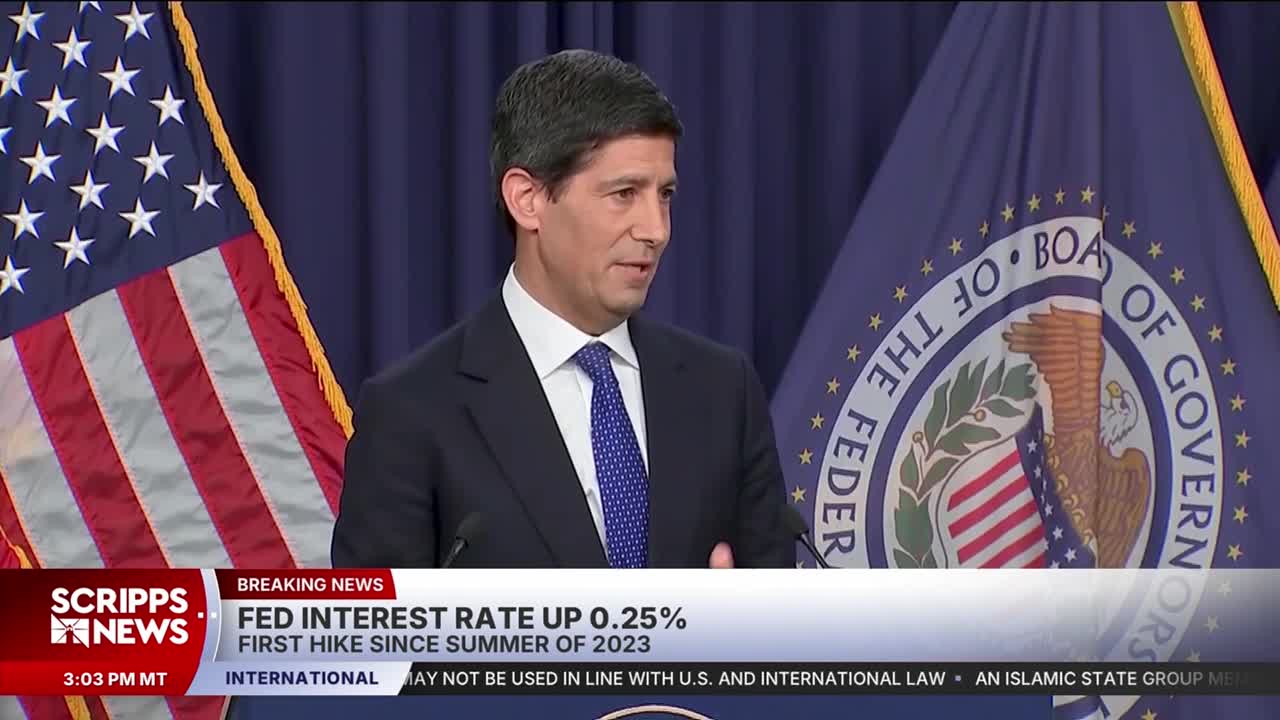


For the first time in more than three years, the Federal Reserve increased interest rates, a move likely to make borrowing more expensive for consumers and businesses.
The decision came despite opposition from President Donald Trump, who has repeatedly called on the Federal Reserve and its chair, Kevin Warsh, to lower rates. Warsh was appointed earlier this year to replace Jerome Powell as chair, though Powell remains a member of the Federal Reserve Board.
The Federal Reserve raised its benchmark interest rate by 0.25 percentage points, returning it to levels seen in late 2025. The vote was unanimous to raise rates.
Persistent inflation, coupled with a stable job market, led the Fed to raise rates. The Federal Reserve aims to keep inflation at an annual rate of 2%. Higher interest rates generally help slow inflation, though they can also weaken the labor market. With inflation running at 3.4% annually and job growth remaining solid, economists widely expected the increase.
"The plain fact is that inflation is too high," Warsh said on Wednesday.
Otherwise, Warsh said, the Federal Reserve "would be hard pressed to describe broad financial conditions as restrictive."
Fed officials believed the U.S. economy remains generally resilient, he said.
"Given that resilience and the potential for even greater performance, an attitude of optimism is exactly what I heard."
Within hours of the Fed's decision, President Trump posted on social media calling for rates to be lowered instead.
"Interest Rates in the United States should be 1%, or less, because we are the Best Credit in the World — BY FAR," the president wrote.
"LOWER THE INTEREST RATES FOR THE UNITED STATES OF AMERICA, AND FAST!"
RELATED STORY | $5K reality check: Experts say Trump's promise of midterm checks would strain the economy
Interest rates remain 1.5 percentage points below their peak levels in late 2023 and early 2024. The Federal Reserve sharply raised rates during that period in response to the highest inflation the U.S. had seen in more than two decades.
The federal funds rate influences the rates banks charge each other for short-term loans. Those higher costs are often passed on to consumers through mortgages, auto loans and credit cards, while also increasing borrowing costs for businesses.
Still, higher interest rates are considered one of the Federal Reserve’s most effective tools for curbing inflation. Before raising rates, policymakers also weigh whether the labor market is strong enough to absorb the economic impact.


